
How to choose between ultrasonic and photoelectric sensors for tag in place detection?
How to choose between ultrasonic and photoelectric sensors for tag in place detection?
As the 'eyes' of the labeling machine, sensors play a crucial role in detecting the placement of labels. With the increasing complexity of label materials and labeling processes, the detection requirements for sensors are also constantly improving.
In modern industry, fully automatic labeling machines have received widespread attention due to their high degree of automation and excellent and reliable performance. As the 'eyes' of the labeling machine, sensors play a crucial role in detecting the placement of labels. With the increasing complexity of label materials and labeling processes, the detection requirements for sensors are also constantly improving.
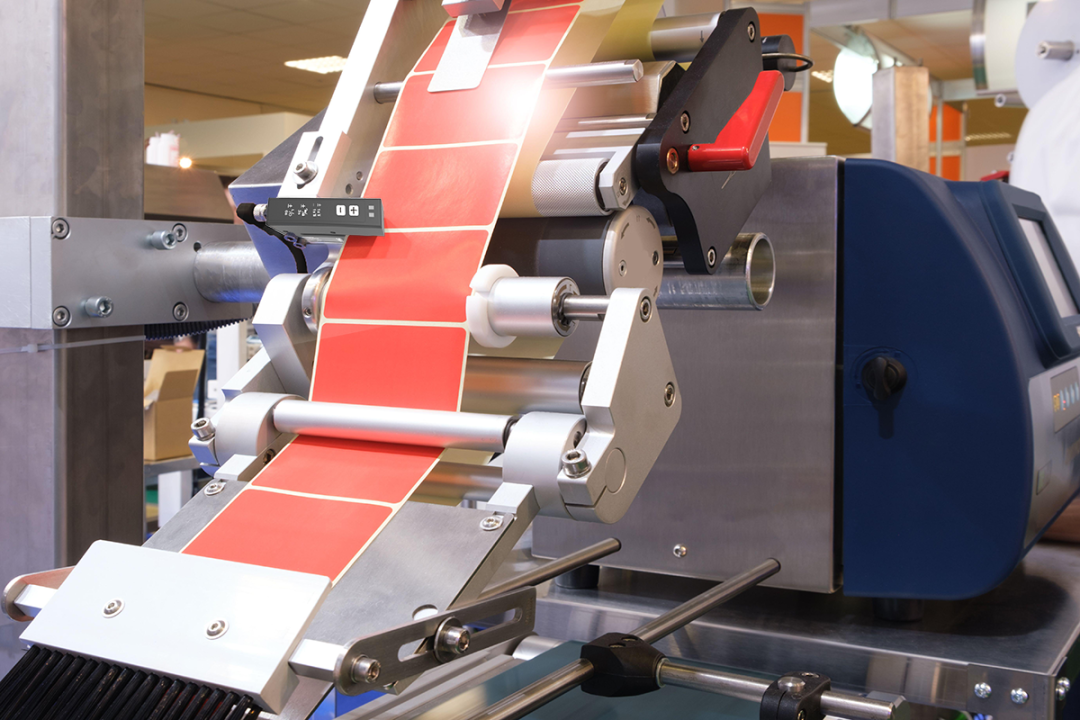
Scenario requirements
During the labeling process of lithium batteries, it is necessary to accurately detect the label's position on the labeling machine in order to promptly send signals to drive the equipment to perform labeling actions; In order to achieve automated labeling, save manpower, and improve efficiency, sensors must be compatible with all commonly used label types and accurately identify each label.
Difficulty analysis:
1. There are various types of labels, including transparent labels, which are difficult for ordinary sensors to accurately detect;
2. Some labels are tightly arranged, requiring sensors to have a fast response frequency;
3. Installation location is limited, only integrated sensors can be installed for detection;
4. The device shakes greatly, and the sensor needs to have a deep groove width to avoid the impact of the measured object.
Solution
To address the above issues, we propose two sensor models, KIM07-0204NP and KUM08-0307N, as solutions.
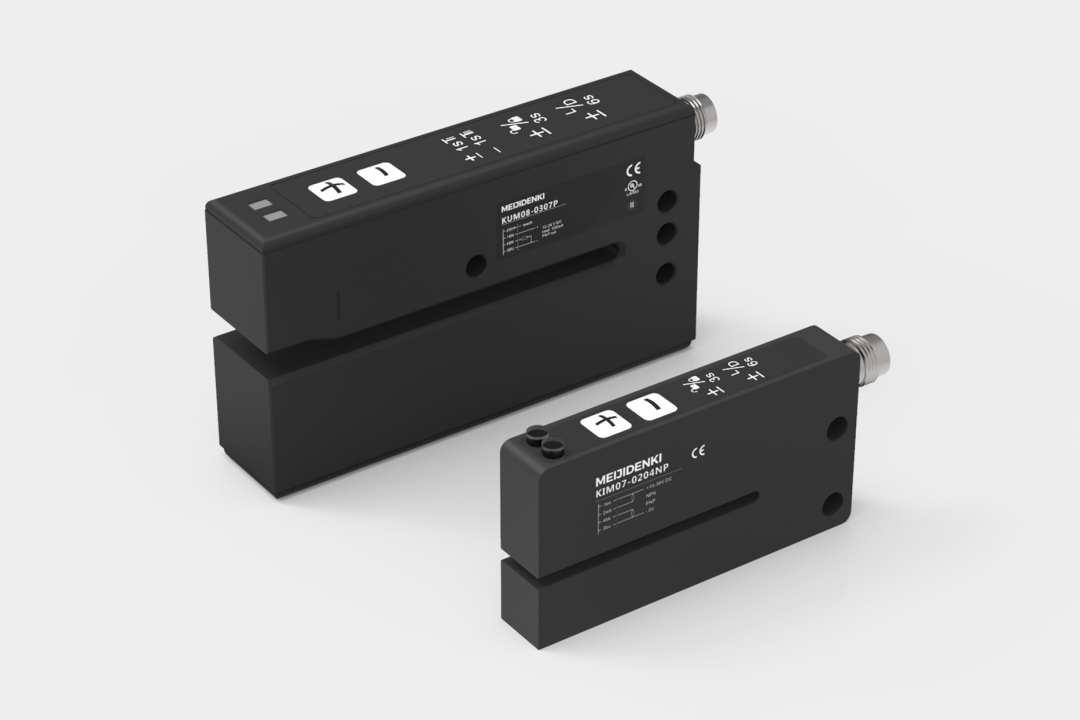
🔸 There are two detection principles to choose from: infrared detection and ultrasonic detection. The KUM series can detect transparent labels, effectively solving a major pain point for users.
🔸 These two sensors can stably detect labels, with a groove depth of 69mm, a fast response frequency, and a maximum response speed of 300us, supporting high-speed labeling machines.
🔸 The ultrasonic principle sensor is not limited by the label material, color, and printing process, and has the functions of two-point teaching and single point teaching, which can be accurately adjusted according to the thickness of the label.
(Ultrasonic principle) Applicable scenarios for label sensors:
When the label is transparent/semi transparent, soft or irregular surface (such as film, foam), multi-color or reflective material, the ultrasonic sensor detects through sound wave reflection and is not affected by label transparency, color or surface deformation.
When detecting the presence of dust in the environment or avoiding environmental light interference, ultrasonic sensors have strong anti pollution ability and do not need to worry about misjudgment caused by changes in light
(Optoelectronic principle) Applicable scenarios for tag sensors:
When the label is made of opaque material (such as paper) and significantly different from the background color, photoelectric sensors (especially reflective or reflective) can achieve accurate detection.
When the detection environment is clean and there is no interference from strong or flickering light sources, the photoelectric sensor responds quickly (in milliseconds), making it suitable for high-speed production lines
+86 18188641602

Akusense Technology Co., Ltd.