
Efficiency increased by 200%! Akusense laser sensor helps woodworking drilling "fast, accurate, and stable"
Efficiency increased by 200%! Akusense laser sensor helps woodworking drilling "fast, accurate, and stable"
The Akusense laser sensor ELE-B35 has successfully solved the high-precision positioning problem of wooden drilling machines through small spot design, high-speed response, and background suppression technology.
A certain head furniture manufacturing enterprise needs to achieve precise connection of upper and lower holes on wooden boards (such as the connection holes between cabinet backboards and side panels). Traditional solutions rely on mechanical limit or manual calibration, and there are the following pain points:
1. Large positioning error: Differences in board thickness and vibration during transportation cause hole displacement;
2. Dust interference: Drilling with drill bits, dust flying, traditional optoelectronics are prone to misjudgment;
3. Low efficiency: manual adjustment takes time and cannot meet the high-speed production needs;
4. High scrap rate: Misalignment of holes leads to product scrap.

To solve the above problems, Akusense recommends using the laser sensor ELE-B35, which achieves the detection of the wooden board in place and the positioning of the hole position through the cooperation of dual sensors, ensuring that the drill bit accurately connects with the hole above on the side.
Sensor selection
Recommend using Akusense laser sensor ELE-B35 installed side by side at the feeding port
Sensor 1 (in place detection): installed at the entrance of the wooden board conveyor line to detect whether the wooden board has reached the drilling station;
Sensor 2 (hole positioning): Installed on the side of the drill bit, it detects the reflected signal of the drilled hole above and locates the position of the side drilling hole.
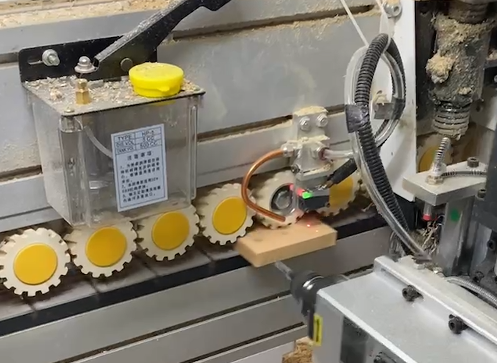
Core parameters:
Spot size:Π 3.5mm/350mm (small spot suitable for high-precision detection);
Switching frequency: 500Hz (meets the requirements of high-speed mobile scenarios);
Detection method: diffuse reflection background suppression (resistant to environmental light interference, adaptable to differences in reflection on the surface of wooden boards);
Protection level: IP67 (dustproof and waterproof, suitable for workshop environment);
Response time: 1ms (quick trigger, reducing delay error)
Actual measurement effect
1. Precision improvement:
Hole position deviation from± 1.2mm reduced to± 0.3mm, Meet the tolerance requirement of 0.5mm in the furniture industry; The qualification rate of connected holes has increased from 82% to 99.5%.
2. Efficiency optimization:
The drilling time for a single piece has been reduced from 12 seconds to 4 seconds, resulting in a 200% increase in production capacity;
The manual calibration process has been completely eliminated, saving 2 operators.
3. Stability verification:
Continuous operation for 72 hours without any faults, and the anti vibration performance of the sensor (10-50Hz, 1.5mm double amplitude) has passed the actual working condition test;
Under ambient light interference testing (incandescent lamp 1000Lux/sunlight 20000Lux), the sensor false triggering rate is 0.
The Meiji laser sensor ELE-B35 has successfully solved the high-precision positioning problem of wooden drilling machines through small spot design, high-speed response, and background suppression technology. The dual sensor collaborative solution not only improves production efficiency, but also ensures hole accuracy through dynamic compensation mechanism, providing a replicable intelligent upgrade path for the furniture manufacturing industry.
If you also have relevant testing requirements, please click to contact us~
+86 18188641602

Akusense Technology Co., Ltd.