In the vast world of optics, polarized light is like a key that quietly opens a new era of sensor optical applications. It is not only a special manifestation of the vibration direction of light waves, but also an indispensable core element in the design of modern industrial sensors.
As early as 10 years ago, Akusense optical engineers incorporated polarization technology into the design of photoelectric sensors. When polarized light meets sensor technology, a revolution in precise measurement, efficient detection and intelligent identification has quietly emerged.
Polarization of light refers to the behavior of light waves vibrating in a specific direction. In layman's terms, light can vibrate like water waves, but the vibration direction of light is not disordered, but vibrates in a specific direction. This characteristic of vibration direction is called polarization of light.
a. Origin of the study of polarized light
In 1669, Danish scientist Rasmus Bartholin first discovered double refraction through quartz crystals - "line magic (a line on paper, two lines seen through quartz)"; in 1690, Huygens discussed this physical phenomenon in detail in "The Theory of Light", but could not explain it; Newton, a contemporary of Newton, speculated on the cause of the double refraction phenomenon, but failed because Newton used the particle nature of light to explain this phenomenon. In 1803, Thomas Young's famous Young's double-slit experiment proved the wave nature of light. In 1808, Malus, the "father of polarization", perfectly explained the double refraction phenomenon based on wave optics, and called this property "polarization", proving that polarization is an inherent property of light. In the second year, he published a paper proposing the famous Malus law, which opened up another new dimension of human cognition of the world.
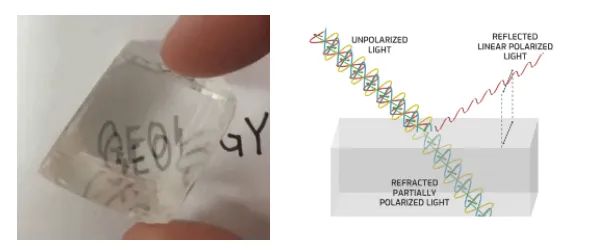
The left picture shows the birefringence phenomenon, and the right picture shows the polarization characteristics of light
Since polarization is a characteristic of wave optics, it needs to be described by wave equations, which makes it too cumbersome and difficult to use in actual measurement, description, and application calculations. Therefore, the genius mathematician Stokes proposed the famous Stoke vector in 1852 to describe polarized light, making polarization simple and clear. You see, the four parameters S0, S1, S2, and S3 (also commonly represented by I, Q, U, and V) form a 4×1 column vector to determine the polarization state of the light wave.
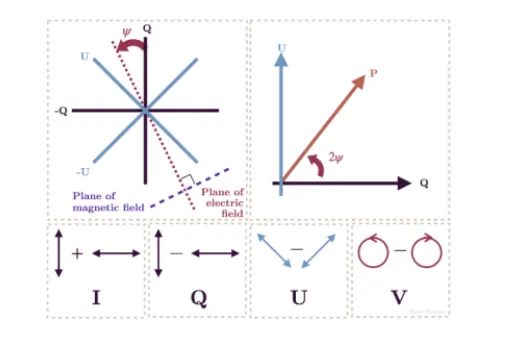
In 1892, Poincaré proposed the Poincaré sphere representation that can intuitively describe the polarization state. In 1941, Jones introduced the Jones vector to describe it, but this method has certain limitations. It is only applicable to completely polarized light. If you want to calculate partially polarized light or non-polarized light, you need to use the Mueller matrix.
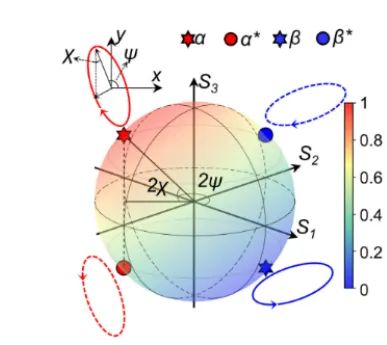
Poincaré sphere
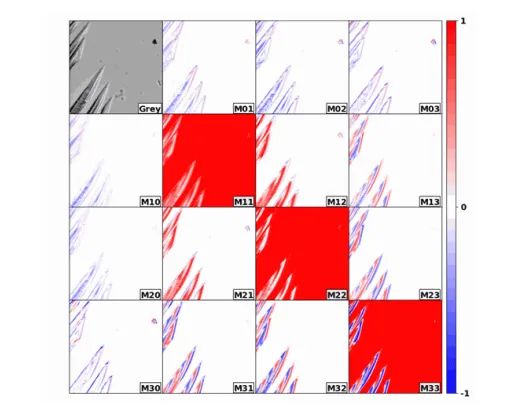
The Mueller matrix was proposed by American physicist Mueller in 1943 to represent the transformation between Stokes vectors. The matrix consists of 4×4 parameters with a total of 16 parameters. For general media, each Mueller matrix element usually has a specific physical meaning. Both Stokes vectors and Mueller matrices can well describe polarization characteristics and play an important role in polarization imaging.
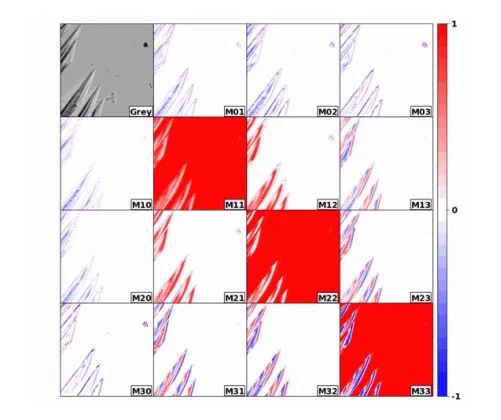
Mueller matrix of nickel sulfate crystal growth process
b. Transverse wave property and polarization state of light
Polarization: asymmetric distribution of wave vibration to propagation direction
Polarization: no matter what the slit is, longitudinal wave can always continue to propagate forward through the slit; while transverse wave can only pass through the slit completely when the slit orientation is parallel to the vibration direction
That is, longitudinal wave is not polarized, transverse wave is polarized → a sign to distinguish transverse and longitudinal waves
Electromagnetic wave belongs to transverse wave. According to the electromagnetic nature of light, light wave is transverse wave and has polarization
Vibration plane: plane formed by the propagation direction and vibration direction of light vector
Illustration of polarized light: on the axis of the light wave propagation direction, short lines are used to represent the light vibration in the vibration plane (paper surface), and dots are used to represent the light vibration perpendicular to the vibration. The number of short lines or origins is positively correlated with the intensity of its vibration
I. High-precision current measurement
In current sensors, polarized light technology shows its unique charm. Polarized light with a fixed vibration direction is generated by a laser light source. When the light passes through the magnetic field generated by the measured current, its polarization direction will change subtly. This change is captured by a precision detector and converted into an electrical signal, thereby achieving high-precision measurement of the current. This technology not only improves the accuracy of the measurement, but also enhances the stability and anti-interference ability of the sensor.
So, how is the accuracy and reliability of polarized light in displacement sensors improved?
The accuracy and reliability of polarized light in displacement sensors are mainly achieved through the following technologies:
1. Polarization modulation technology: The polarized light is modulated using the Miller matrix, and two staggered polarization directions are orthogonal to form an image grating through a combination of a polarizer, a Savart plate, two 1/4 wave plates, a photoelastic modulator and an analyzer. This technology can effectively eliminate the measurement errors introduced by light source intensity fluctuations and circuit gain changes, suppress the influence of stray light and detector noise, and thus improve measurement accuracy.
2. Polarized light linear displacement sensor implemented by DSP: Based on the polarization characteristics of light, Malus's theorem and Faraday's optical rotation effect, the same light source dual optical path detection is used to achieve the measurement of a large range of linear displacement. This method improves the accuracy and reliability of the displacement sensor through digital signal processing (DSP) technology.
3. Multi-directional polarized light real-time positioning technology: The polarized light navigation sensor in the multi-directional array structure detects the polarized light information in multiple directions of the sky in real time, and performs optimization and fusion processing to calculate more reliable and accurate position information. This method not only improves the positioning accuracy, but also enhances the real-time and reliability of the system.
4. Bionic polarized light navigation sensor design: Direction information is obtained through the polarized light information of the sky, and the position information is obtained in combination with the GPS receiver. The wavelet denoising method is used to filter the sensor output signal, and the least squares method and the least squares vector machine method are used to compensate for the inherent error of the sensor, which significantly improves the accuracy of the sensor.
5. Polarization diversity technology: The application of polarization diversity technology in optical fiber sensors can greatly alleviate the problem of polarization fading, and achieve stable signal detection through phase carrier modulation and demodulation technology, thereby improving the accuracy and reliability of the system.
II. Visual inspection and imaging
In the field of industrial visual inspection, polarization cameras use the characteristics of polarized light to greatly improve the accuracy and efficiency of detection. Traditional cameras are often unable to cope with highly reflective or low-contrast objects, while polarization cameras can filter out unnecessary reflected light, enhance the contrast of the image, and make scratches, dents and other minor defects invisible.
AKUSENSE smart code reader effect with polarized light
In addition, polarization cameras can also reveal the stress distribution and material properties of the surface of an object by coloring the polarization angle, providing a powerful tool for quality control and material analysis.
III. Stress and deformation detection
In the field of materials science and engineering, polarization light technology is widely used in the detection of stress and deformation. When polarized light passes through a stressed or deformed material, its polarization state changes. By measuring this change, the stress distribution and deformation degree of the material can be accurately evaluated. This is of great significance for ensuring structural safety and optimizing material design.
c. Communication and sensing technology
In the field of communication, polarized light is also used as a carrier for information transmission. By modulating the polarization state of polarized light, high-speed and large-capacity data transmission can be achieved. At the same time, in fiber optic sensing technology, polarized light is used to detect small changes in optical fibers, such as changes in physical quantities such as temperature and pressure, thereby achieving real-time monitoring of environmental parameters.
The application of polarized light in sensor optics not only broadens the application field of sensors, but also improves the performance and accuracy of sensors. With the continuous development of science and technology, we have reason to believe that polarized light technology will show its unique charm and value in more fields. Let us look forward to the infinite possibilities brought by this optical revolution led by polarized light!