
AS5000 Series LiDAR: A Fully Solid-State Solution for Industrial Automation and Smart Surveillance
2025.03.15
In the era of Industry 4.0, intelligence, automation, and efficiency have become the core drivers of manufacturing development. As a critical component of industrial automation systems, the performance and reliability of sensors directly impact overall production efficiency and quality. In recent years, LiDAR sensors have gained widespread adoption in industrial applications due to their high precision, long-range detection, and strong environmental adaptability.
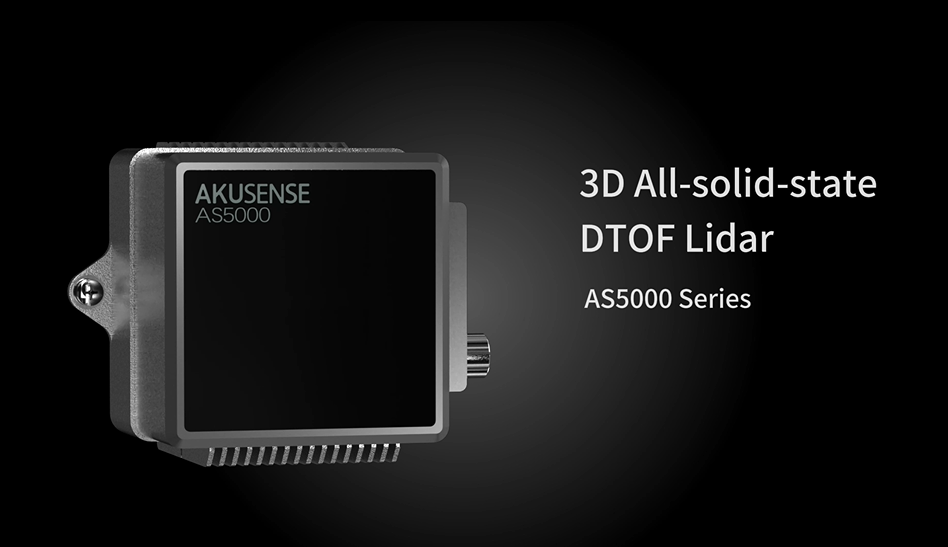
This article focuses on the AS5000 Series fully solid-state array DTOF LiDAR launched by Meiji Sensing, exploring its technological advancements and application prospects in the Industry 4.0 landscape.
I. Evolution and Current State of LiDAR Technology
LiDAR (Light Detection and Ranging) is a technology that uses laser beams to measure distance and detect objects. Since its introduction in the 1960s, LiDAR technology has evolved from mechanical systems to semi-solid-state and ultimately to fully solid-state designs.
- Mechanical LiDAR relies on internal rotating components for scanning. While offering high precision and resolution, it is complex, costly, and less reliable due to mechanical wear.
- Semi-Solid-State LiDAR reduces mechanical parts, enhancing stability and durability, yet still retains some moving components.
- Fully Solid-State LiDAR marks a significant breakthrough, eliminating all mechanical components and adopting electronic scanning technology. This not only enhances scanning speed and accuracy but also significantly reduces costs, making it highly competitive for industrial applications
II. Key Features of AS5000 Series Fully Solid-State Array DTOF LiDAR
The AS5000 Series represents the latest advancements in fully solid-state array DTOF (Direct Time-of-Flight) LiDAR technology. It is based on SPAD (Single-Photon Avalanche Diode) array DTOF combined with FLASH laser technology, enabling direct 3D point cloud data output with detailed object features.
1. Motion-Free Design
One of the most significant innovations of the AS5000 Series is the complete elimination of internal moving parts. Traditional mechanical LiDAR systems are prone to wear and failure due to rotating components, leading to reduced accuracy and downtime. By adopting a fully solid-state design, the AS5000 Series eliminates these reliability concerns, significantly enhancing stability and operational lifespan.
2. High Resolution and Long-Range Detection
- Point Cloud Resolution: 360 × 150, delivering high-precision 3D data.
- Effective Detection Range: 0.3–20 meters (10% reflectivity), with a maximum range of up to 50 meters.
This ensures precise measurements over long distances, meeting industrial demands for large-scale monitoring and high-accuracy positioning.
3. Superior Environmental Adaptability
Industrial environments present various challenges, including harsh lighting and weather conditions. The AS5000 Series offers:
- Strong light resistance up to 100 kLux, ensuring reliable performance under direct sunlight.
- Weather resilience, effectively operating in rain, fog, and dust.
These features make it highly reliable for outdoor industrial applications, providing stable and accurate point cloud data regardless of environmental conditions.
4. Integrated SoC Processing Unit
Equipped with an onboard System-on-Chip (SoC), the AS5000 Series can process and output 3D point cloud data directly. This integrated design:
- Enhances data processing speed for real-time applications.
- Reduces dependence on external computing resources, lowering overall system complexity and cost.
III. Industrial Applications of AS5000 Series in Industry 4.0
1. Autonomous Vehicle Navigation (SLAM)
In industrial logistics and warehousing, Autonomous Guided Vehicles (AGVs) are increasingly used. The AS5000 Series LiDAR enables AGVs to:
- Provide high-precision environmental perception for accurate navigation.
- Support SLAM (Simultaneous Localization and Mapping), generating 3D maps in real-time.
- Facilitate autonomous path planning and obstacle avoidance, improving efficiency and safety.
2. V2X Roadside Monitoring
As a key component of Vehicle-to-Everything (V2X) technology, AS5000 Series LiDAR supports:
- Real-time traffic monitoring, detecting vehicles and pedestrians with high accuracy.
- Reliable performance under varying light conditions, ensuring data accuracy for smart traffic management and autonomous vehicle assistance.
3. Railway Security
Rail transportation safety is a critical concern. AS5000 Series LiDAR can be deployed along railway lines to:
- Continuously monitor tracks and surrounding areas for obstacles or anomalies.
- Ensure stable operation in harsh weather conditions, including fog and rain.
- Enhance early warning systems, preventing accidents and ensuring smooth rail operations.
4. Perimeter Security for Industrial Facilities
Industrial sites, such as factories and warehouses, require robust security solutions. The AS5000 Series provides:
- 360° real-time surveillance, detecting unauthorized access or suspicious objects.
- High-resolution scanning, ensuring accurate identification even in complex lighting conditions.
- Reliable operation in various environments, improving safety and asset protection.
IV. Future Outlook of AS5000 Series LiDAR
As Industry 4.0 advances, LiDAR sensors will play an increasingly crucial role in industrial automation. The AS5000 Series stands out due to its motion-free design, high resolution, long-range detection, and superior environmental adaptability, making it a strong contender across multiple industrial applications.
Future developments may include:
- Enhanced SPAD and FLASH laser technologies, further improving point cloud resolution and detection accuracy.
- Upgraded SoC processing, enabling faster data handling and more advanced AI algorithms.
- Deeper integration with AI and IoT, enabling intelligent object recognition, behavior analysis, and decision-making.
- Interconnectivity with industrial IoT ecosystems, transforming LiDAR into a key sensing node for fully automated smart industries.
V. Conclusion
The AS5000 Series Fully Solid-State Array DTOF LiDAR represents a breakthrough in sensor technology for Industry 4.0. With its motion-free design, high-resolution point cloud output, long-range capabilities, and exceptional adaptability, it has proven highly effective in applications such as:
- Autonomous vehicle navigation (SLAM for AGVs and industrial robots).
- V2X roadside traffic monitoring for smart city and transportation systems.
- Railway security monitoring to enhance operational safety.
- Perimeter security for industrial facilities, ensuring asset and personnel protection.
As LiDAR technology continues to evolve and integrates further with AI and IoT, the AS5000 Series is poised to play an even more significant role in industrial automation, smart surveillance, and the broader Industry 4.0 transformation.
Related Products
+86 18188641602

Akusense Technology Co., Ltd.