
The Smart Sensing Revolution in Industry 4.0: Technical Breakthroughs and Industrial Value of 3D All-solid-state DTOF Lidar
2025.03.15
Introduction
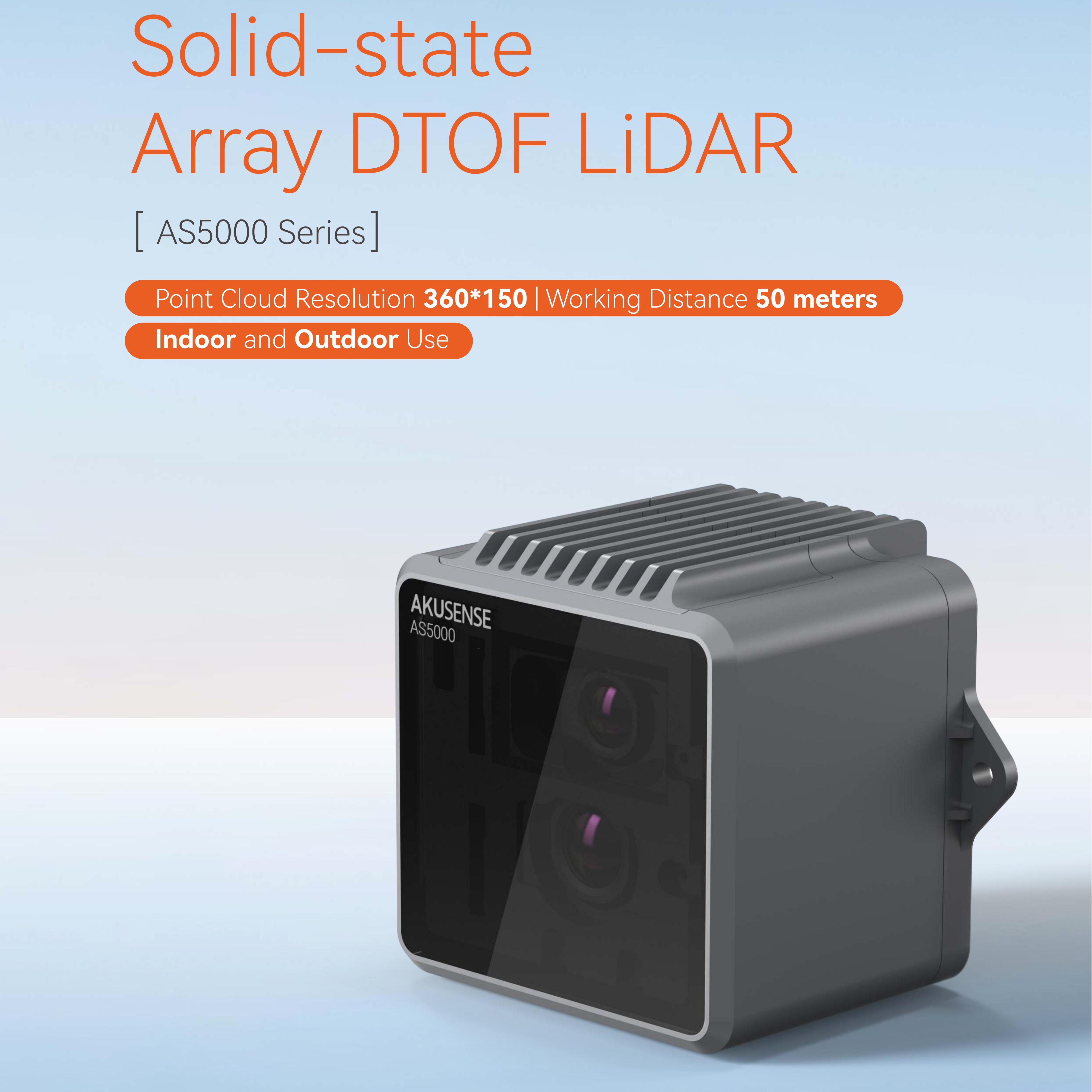
In the era of deep integration between Industry 4.0 and smart manufacturing, high-performance LiDAR is emerging as a core sensor enabling the digital transformation of industries. This article provides an in-depth analysis of the AS5000 series all-solid-state focal-plane DTOF LiDAR from AKUSENSE, based on the latest technical whitepapers and industry trends.
I. New Requirements for Smart Sensing in Industry 4.0
With the number of connected devices on industrial internet platforms exceeding 50 billion (McKinsey 2024 Global Industry Report), traditional sensors face increasing limitations in precision, anti-interference capability, and integration. The AS5000 series delivers 360°×150° high-density point cloud output through its all-solid-state focal-plane architecture, achieving a 40% improvement in spatial resolution compared to traditional multi-line LiDARs.
II. Technological Innovations Driving Industrial Upgrades
1. Design Revolution Without Moving Parts
By integrating FLASH laser technology with SPAD focal-plane arrays, the AS5000 becomes the industry’s first LiDAR to eliminate mechanical rotating structures entirely. This design not only extends MTBF (Mean Time Between Failures) to over 50,000 hours but also achieves IP67-rated protection, ensuring operation in extreme environments from -40°C to +70°C.
2. All-Weather Environmental Adaptability
Equipped with self-developed dynamic gain control algorithms, the product maintains stable ranging under 100KLux intense sunlight. Combined with patented anti-scattering optical modules, it reduces ranging attenuation by 65% in rainy/foggy conditions, addressing performance degradation issues common in traditional LiDARs.
III. Multi-Dimensional Industrial Applications
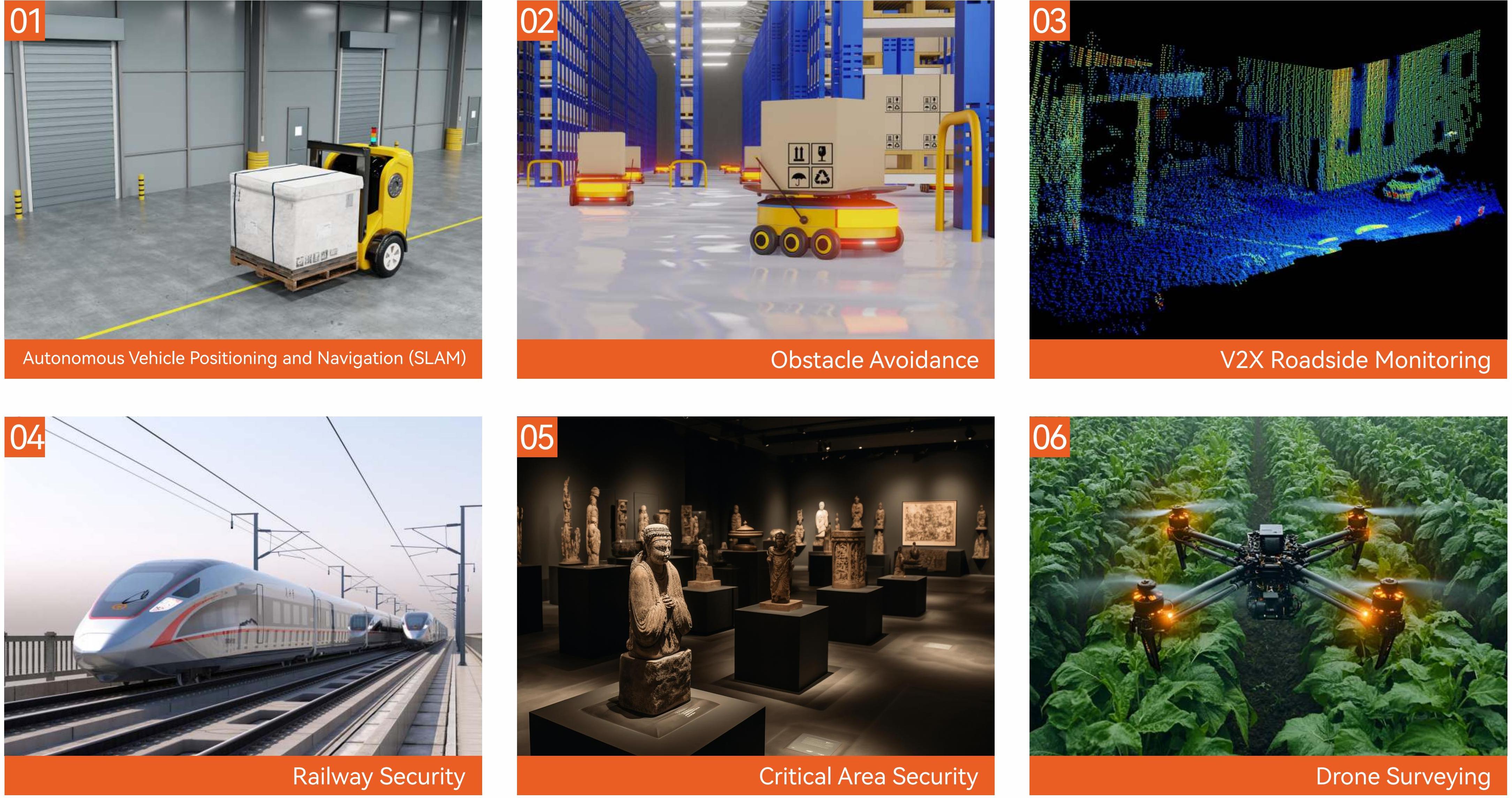
1. Smart Logistics Systems
In AGV navigation, the AS5000’s 50-meter ranging capability (20 meters effective at 10% reflectivity) and 200Hz refresh rate enable millimeter-level obstacle detection. With V2X protocol support, it provides real-time environmental perception for flexible production lines.
2. Precision Manufacturing Monitoring
In 3C electronics assembly scenarios, its 360°×150° point cloud resolution can detect workpiece deformations as small as 0.1mm. Combined with AI algorithms, it achieves real-time production line anomaly alerts, increasing detection efficiency threefold compared to traditional vision systems.
3. Specialized Security Applications
In railway perimeter protection, motion trajectory tracking based on focal-plane imaging enables automatic classification of intrusions, reducing false alarm rates by 82% compared to traditional solutions. It has been successfully applied in national projects like the Beijing-Shanghai High-Speed Railway.
IV. Technological Evolution and Industrial Outlook
According to Yole Development, the industrial LiDAR market is projected to exceed $2.3 billion by 2026, with a compound annual growth rate of 28.7%. The AS5000 series’ SOC integration design reduces core processing unit size by 60%, providing a cost-effective path for lightweight industrial equipment upgrades.
Conclusion
At the intersection of Industry 4.0 and AIoT, all-solid-state focal-plane LiDAR technology is reshaping industrial competition. The AS5000 series’ technical breakthroughs not only enhance existing industrial applications but also lay the foundation for full-factor digitalization in smart factories.
Related Products
+86 18188641602

Akusense Technology Co., Ltd.