
Ring-Shaped Safety Light Curtain Flexible Protection System
2026-01-23 16:30:00
In traditional industrial automation environments, to ensure personnel safety, robotic arms are usually isolated by fixed fences or surrounded by bulky safety light curtains. This "hard isolation" method sacrifices the flexibility and production efficiency of human-machine collaboration.
Facing the demands of modern manufacturing for small-batch, multi-variety production models, close human-machine collaboration has become key to improving production efficiency. Traditional safety light curtains have limitations such as insufficient flexibility, limited installation space, and high costs, making it difficult to meet the needs of flexible production.
AKUSENSE Sensing's innovative solution integrates the transmitter, receiver, and signal processing into a single module, revolutionizing the traditional light curtain protection model. This ring-shaped safety light curtain can be easily installed on the arm of a robotic arm, enabling the robotic arm to intelligently sense the approach of personnel, achieving "stop when a person approaches, resume when a person leaves" flexible protection, solving the safety problem of human-machine collaboration in confined spaces.
Ring-Shaped Light Curtain
Safety Protection Solution
Based on AKUSENSE Sensing's integrated "optical, mechanical, electrical, and software" technology platform, the solution integrates optical and mechanical design with chip and dynamic random algorithm technology to create a high-performance industrial safety solution.
The sensor accurately determines the distance between personnel and the robotic arm by emitting a light beam and detecting the light reflected back from obstacles. When personnel enter the preset safety distance range, the system immediately sends a stop signal, and the robotic arm instantly stops moving; when personnel leave, the robotic arm automatically resumes operation.
Solution Highlights
Innovation Highlight One: Flexible Installation
Traditional light curtains are almost entirely based on the through-beam principle, with separate transmitters and receivers, requiring two installation points, limiting installation and usage scenarios.
Unlike traditional safety light curtains that require through-beam installation, AKUSENSE Sensing's solution can be directly integrated into the robotic arm body. This integrated design significantly saves equipment space and simplifies system integration.
Innovation Highlight Two: Fast Response
AKUSENSE Sensing's solution uses the optical reflection principle, non-contact detection, with a rapid response speed of ≤5ms and a long detection distance, ensuring that the robotic arm stops in time before potential hazards occur.
Innovation Highlight Three: Enhanced Background Suppression for Improved Reliability
The solution employs advanced background suppression technology, resulting in minimal black-and-white contrast differences and enabling stable detection of objects of any color at a fixed position. It effectively eliminates interference from background objects, reacting only to objects within a preset distance. This feature makes it particularly suitable for complex industrial environments, ensuring stable and reliable detection.
Innovation Highlight Four: High Stability
This solution incorporates advanced anti-interference algorithms, possessing excellent anti-interference capabilities. Even in complex industrial environments with strong light interference (incandescent light ≤ 1000 Lux; sunlight ≤ 10000 Lux) and EMC interference, the sensor can operate stably, effectively avoiding false triggers. This feature is crucial for ensuring production continuity.
Innovation Highlight Five: High Scalability
Multiple shapes, sizes, and detection distances of light curtains can be quickly customized according to specific needs, adapting to a wider range of application scenarios.
Solution Advantages
AKUSENSE Sensing's human-robot collaboration safety solution effectively prevents mechanical arms from causing harm to operators while ensuring that production cycles remain unaffected. The economic benefits are evident.
1. The significant reduction in human-robot collaboration distance allows for a more compact production line layout, reducing equipment footprint and optimizing space utilization.
2. Because safety protection is directly integrated into the robotic arm, there is no need to set up large safety isolation zones. Personnel can approach the equipment more quickly for maintenance and debugging, significantly reducing production downtime.
3. When personnel approach, the robotic arm automatically slows down or pauses; once personnel leave, the robotic arm immediately resumes operation, avoiding the recovery delays common in traditional safety systems.
Other Typical Application Scenarios
Scenario 1: Semi-Automatic Assembly
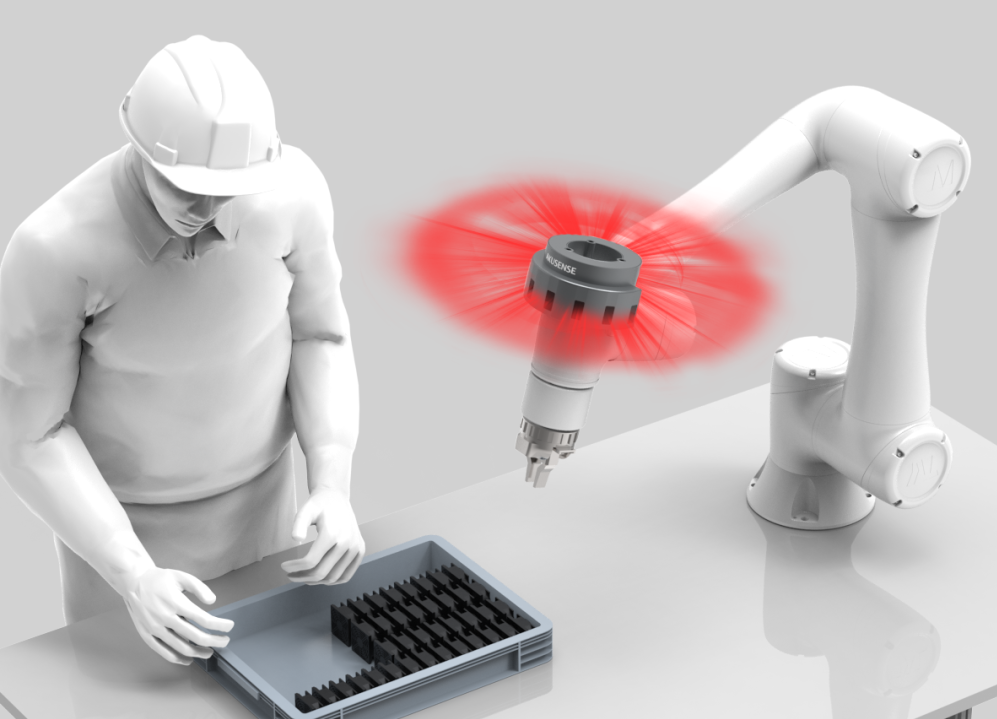
In a semi-automatic assembly workshop for electronic products, operators collaborate with robots to assemble complex components. When an operator approaches the robot's work area with small parts for assembly, the circular safety light curtain quickly forms a dynamic safety isolation zone, monitoring hand position in real time. If the hand enters the danger zone, the robot immediately pauses and automatically resumes operation after the hand leaves the zone. This mode leverages the advantages of robots, ensuring personnel safety and improving assembly efficiency and product quality.
Scenario 2: Workpiece Replenishment
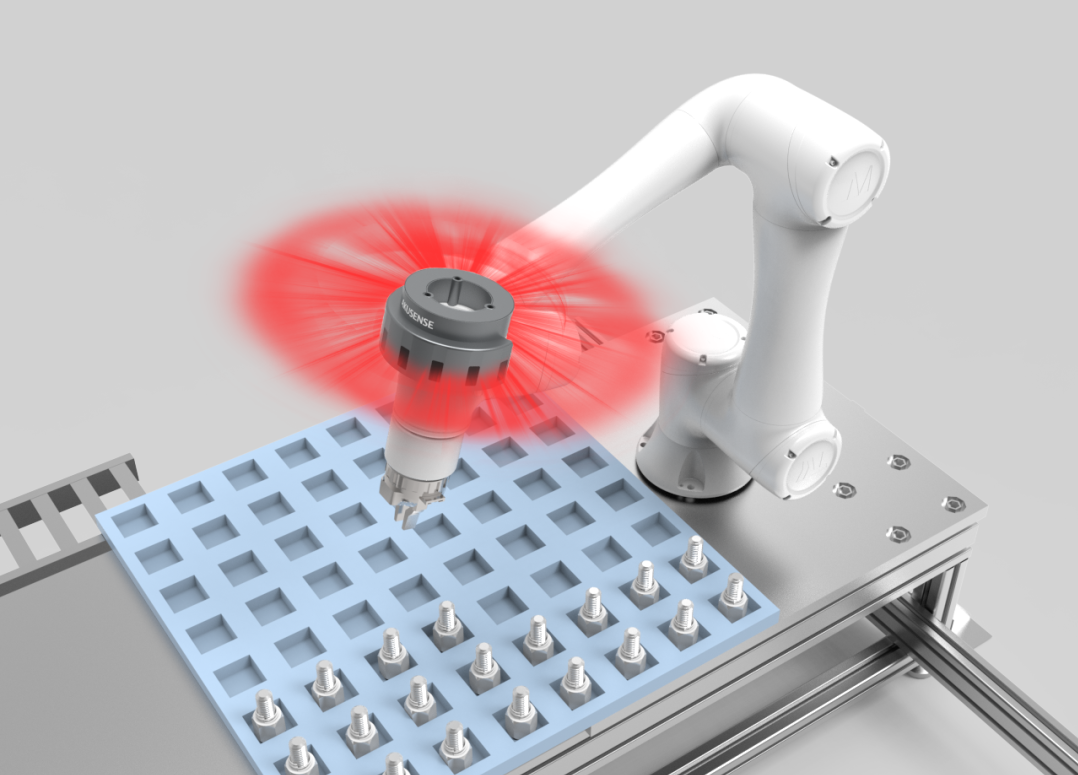
When operators replenish workpieces on the workpiece tray, the robot can continue to operate normally without requiring a complete shutdown, improving processing efficiency. Meanwhile, the circular safety light curtain provides safety protection, ensuring that there is no risk of hand pinching during human-robot collaboration, thus enhancing workers' acceptance of the collaborative mode.
This evolutionary solution, from passive protection to active collaboration, is a key breakthrough in achieving flexible production lines. It marks a new stage of human-robot collaboration characterized by "zero accidents and high efficiency." The balance between its economic viability and innovative features is injecting safer and smarter genes into intelligent manufacturing.
+86 18188641602

Akusense Technology Co., Ltd.